The world of modern swine farming is a relentless pursuit of efficiency, a constant battle against razor-thin margins and the demanding realities of livestock management. For decades, the success of a farm has hinged on the farmer’s intuition, experience, and sheer physical labor. Yet, one of the most critical factors—the barn environment—remains a persistent source of inefficiency and financial drain in traditional operations.
The problem is simple: traditional environmental control—managing ventilation, temperature, and humidity—is manual, reactive, and highly labor-intensive. Farmers are forced into a constant, exhausting cycle of monitoring conditions and making manual adjustments based on changing weather, the pigs’ growth stage, and even the time of day. This human-centric approach is inherently inconsistent, leading to fluctuating barn conditions that stress the animals, increase disease susceptibility, and ultimately, translate into significant financial losses through slower growth and higher mortality. The financial impact of a single, poorly ventilated day can ripple through an entire production cycle, costing thousands in lost potential.
The time for human guesswork is over. We are at the dawn of a new era in livestock management, one defined by precision and automation.
Introducing Trackfarm’s Automated Environmental Control (AEC) system. This is not merely an incremental upgrade to existing barn technology; it is a fundamental economic restructuring tool. By shifting control from fallible human hands to an AI-driven, proactive system, Trackfarm’s AEC delivers massive, quantifiable savings in labor, operational costs, and mortality rates. It transforms the barn from a reactive environment into a perfectly optimized, predictable production facility, ensuring that every day is a maximum growth day.
II. The Labor Drain: Why Traditional Control Fails to Scale
The sheer scale of modern farming presents an insurmountable challenge for manual control. Consider the 3,000-Head Challenge: a single manager, no matter how dedicated, struggles to maintain optimal, consistent conditions across multiple large housing units. The physical and mental toll of this constant vigilance is immense, and the inevitable human error is costly. The reality is that a human manager can only be in one place at a time, and their attention is divided across feeding, health checks, maintenance, and, critically, environmental control.
The daily grind of traditional environmental management involves a cycle of low-value, high-stress tasks:
- Constant Monitoring: Checking thermometers, humidity gauges, and air quality indicators multiple times a day, often requiring walking the length of multiple barns.
- Manual Adjustments: Physically opening and closing vents, adjusting fan speeds, and regulating heating and cooling systems based on subjective judgment rather than precise data.
- Reactive Response: Waiting for conditions to degrade (e.g., ammonia levels rising or temperature spiking) before taking corrective action. This reactive approach means the pigs have already suffered a period of stress, which immediately impacts their growth and health.
This labor-intensive, reactive approach creates a cost of inconsistency that erodes profitability in three critical ways:
- Slower Growth Rates (Lost Time): Pigs under thermal or respiratory stress divert energy from growth to survival, extending the time required to reach market weight. Every extra day in the barn is an extra day of feed, labor, and overhead costs.
- Increased Feed Conversion Ratio (FCR) (Wasted Resources): Stressed pigs eat more but gain less, meaning more feed is wasted for the same output. Feed is the single largest cost in swine production, and even a marginal increase in FCR can cost a large farm hundreds of thousands of dollars annually.
- Higher Veterinary Costs (Risk Management Failure): Fluctuating conditions, especially poor ventilation leading to high ammonia levels, are primary triggers for respiratory issues. This necessitates expensive medication, veterinary intervention, and often results in permanent damage to the herd’s health.
Trackfarm’s core promise is to eliminate this labor drain. Its technology is designed to minimize human intervention, allowing one manager to confidently oversee 3,000 or more pigs, a feat impossible under traditional manual control. The manager’s role is elevated from a manual laborer to a strategic supervisor.
III. Trackfarm’s Automated Environmental Control (AEC): Precision in Action
The Trackfarm AEC system is a sophisticated, closed-loop optimization engine that operates with a level of precision and foresight that no human can match. It is the fusion of cutting-edge sensor technology, powerful cloud analytics, and robust hardware automation, working together to create a perfectly stable microclimate.
The Sensor Network: The Eyes and Ears of the Barn
The system begins with a comprehensive network of industrial-grade sensors strategically placed throughout the housing unit. These sensors go far beyond simple temperature checks, providing a multi-dimensional view of the barn’s atmosphere. They continuously monitor all critical environmental parameters:
- Physical: Temperature (at multiple heights), humidity, air pressure, and air velocity.
- Chemical: Ammonia (NH3), Carbon Dioxide (CO2), and Hydrogen Sulfide (H2S) levels, which are direct indicators of air quality and waste management effectiveness.
- Biological: Sensors can even detect subtle changes in air composition that indicate the onset of biological activity or disease vectors.
This constant stream of real-time data provides a complete, granular picture of the barn’s microclimate, identifying potential issues long before they become visible problems. The data is collected every few seconds, providing a resolution of environmental change that is impossible for a human to track.
The AI Brain: Predictive Optimization and Data Mining
The raw data collected by the sensors is fed into the Trackfarm AI engine, which resides in the cloud. This is where the magic of data mining and cloud analysis occurs. The AI doesn’t just react to current conditions; it uses predictive modeling to anticipate environmental needs, a core component of its value proposition.
- Data Mining and Pattern Recognition: The AI continuously mines historical data from the farm (and anonymized data from the entire Trackfarm network) to identify complex patterns. It learns, for example, how a specific combination of outside temperature, wind speed, and pig age will affect the barn’s internal ammonia levels in the next two hours.
- Forecasting and Proactive Control: Based on external weather forecasts, the pigs’ current growth stage, and the historical data patterns, the AI predicts how the barn environment will change. This allows it to initiate corrective actions before the environment deviates from the optimal zone. For instance, it might preemptively increase ventilation slightly an hour before a predicted temperature spike.
- Optimization Algorithms: The system runs complex algorithms to determine the exact minimum adjustment required to maintain the optimal zone for the pigs. This is a delicate balance: maximizing animal welfare while minimizing energy expenditure. The AI constantly seeks the most energy-efficient way to achieve the perfect climate.
- Guideline/Alerts: The system is designed for exception-based management. It handles 99% of the environmental control autonomously. It provides clear, actionable alerts to the manager only when an anomaly is detected that requires human intervention (e.g., a hardware failure or an unexpected biological event).
Hardware Automation: Seamless and Energy-Efficient Control
The AI’s decisions are instantly translated into precise commands for the barn’s hardware, ensuring immediate and accurate response. This includes:
- Variable Speed Ventilation Systems: Fans are adjusted not just in speed, but in direction and flow rate, ensuring uniform air quality throughout the barn and eliminating dead zones where harmful gases can accumulate.
- Automated Opening and Closing Systems: Automated windows, curtains, and inlets are controlled with millimeter precision to manage natural ventilation and temperature buffering, leveraging natural air movement whenever possible to save energy.
- Climate Mechanisms: Heaters, coolers, and misters are activated only when and where necessary, often in localized zones, ensuring energy is never wasted on heating or cooling empty or already-optimal areas.
This seamless, automated control loop ensures that the environment remains within the tightest possible optimal range, 24 hours a day, 7 days a week, eliminating the costly inconsistencies of manual control.
IV. Quantifying the Savings: Cost Reduction Deep Dive
The true value of the Trackfarm AEC system is measured in its economic impact. By automating environmental control, the system attacks the three largest cost centers in swine farming: labor, operational expenses, and animal loss.
A. Labor Savings: The 99% Efficiency Leap
The most immediate and dramatic impact is the reduction in labor. The AI system effectively takes over the constant, low-value task of environmental monitoring and adjustment, achieving the goal of minimizing human labor.
| Metric | Traditional Farm (Manual Control) | Trackfarm AEC System | Savings/Improvement |
|---|---|---|---|
| Labor Hours per 1,000 Pigs/Day | 4.0 hours | 0.5 hours | 87.5% Reduction |
| Manager Capacity | ~1,500 pigs | 3,000+ pigs | 100%+ Increase |
| Annual Labor Cost Reduction (3,000-head farm) | N/A | $70,000 – $100,000 | Direct Payroll Savings |
| Task Focus | Reactive Adjustments | Exception Management | Shift to High-Value Work |
The economic benefit of the 3,000+ pigs per manager metric is profound. It means a farm can double its capacity without increasing its management staff, or drastically reduce its existing labor force, leading to a direct and permanent reduction in payroll costs. The manager’s role shifts from a laborer constantly fighting environmental fluctuations to a strategic supervisor focused on high-value tasks like animal health checks, maintenance, and long-term planning. This shift in focus also leads to better overall farm management, creating a positive feedback loop for profitability.

B. Operational Cost Savings: Energy and Feed Efficiency
The precision of the AEC system translates directly into lower utility bills and better feed utilization, optimizing the farm’s largest variable costs.
1. Energy Optimization: Manual control often results in over-ventilation or over-heating/cooling, wasting vast amounts of energy. A farmer might leave a fan running too long “just in case” or overheat a barn to compensate for a draft. The AI’s precise, data-driven control eliminates this waste. It ensures that fans run at the optimal speed, and heating/cooling is localized and minimized, leading to significant reductions in electricity and fuel consumption, often exceeding 20% savings compared to manual or simple thermostat-based systems.
2. Feed Conversion Ratio (FCR) Improvement: This is arguably the most critical economic driver. Pigs maintain their best FCR when they are in a state of thermal neutrality—neither too hot nor too cold, and breathing clean air. When the environment is perfectly stable, pigs are not stressed, and their energy is dedicated entirely to growth. A small percentage improvement in FCR can save tens of thousands of dollars annually on a large farm. For example, moving FCR from 2.85 to 2.70 on a 3,000-head farm can save over $50,000 per year in feed costs alone.
C. Mortality and Growth Cycle Savings
The AEC system is a powerful preventative health tool, safeguarding the farm’s most valuable asset: the livestock.
1. Reduced Mortality Rate: Stable, clean air conditions drastically lower the incidence of common respiratory diseases, which are often triggered by ammonia buildup or sudden temperature drops. By minimizing stress and disease vectors, the system directly saves the cost of lost animals and the associated disposal costs. A reduction in mortality from 5.0% to 2.5% on a 3,000-head farm represents a direct saving of 75 animals per year, a substantial economic gain.
2. Shorter Rearing Cycle (Time to Market): When pigs are consistently in their optimal environment, they grow faster. This means they reach market weight days or even weeks sooner. This increased throughput allows the farm to cycle more herds through the facility annually, maximizing the return on capital investment. Saving 10 days per cycle can translate into an extra production cycle every few years, dramatically boosting overall farm revenue.
V. The Synergy: AEC and AI Monitoring
While the AEC system focuses on the physical environment, its true power is realized when combined with Trackfarm’s AI Monitoring (SW) system. The two components create a holistic, self-optimizing farm.
The AI Monitoring system handles:
- Individual Pig Management: Counting, growth analysis, and slaughter timing prediction.
- Labor Minimization: AI replaces 99% of human tasks related to individual animal tracking.
The AEC system ensures that the environment is perfect for the AI Monitoring to function optimally. A dusty, poorly lit, or stressed environment can interfere with camera-based monitoring. By providing a stable, clean environment, the AEC system guarantees the accuracy and reliability of the AI Monitoring, creating a powerful synergy: Perfect Environment + Perfect Management = Maximum Profitability.
VI. Visualizing the Impact: Data and Optimization
To fully appreciate the systemic change Trackfarm introduces, it is helpful to compare the economic outcomes and visualize the process.
Economic Comparison: Manual vs. Automated Control (Detailed)
| Metric | Traditional Farm (Manual Control) | Trackfarm AEC System | Savings/Improvement | Economic Impact (3,000-head farm) |
|---|---|---|---|---|
| Annual Labor Cost | $100,000 | $30,000 | 70% Reduction | $70,000 Saved |
| Feed Conversion Ratio (FCR) | 2.85 | 2.70 | 5.3% Improvement | $50,000+ Saved |
| Annual Mortality Rate | 5.0% | 2.5% | 50% Reduction | 75 Animals Saved |
| Time to Market Weight | 180 days | 170 days | 10 days saved | Increased Annual Throughput |
| Energy Cost per Pig | $15.00 | $12.00 | 20% Reduction | $9,000 Saved |
Note: Figures are illustrative based on industry averages and reported case study outcomes, demonstrating the potential for over $129,000 in annual savings and increased revenue.
The Trackfarm AEC Feedback Loop: From Sensor to Savings (Diagram Idea)
The AEC system operates on a continuous, self-optimizing loop that ensures constant peak performance:
- Sensors: Collect real-time data (Temp, Humidity, Ammonia, Airflow).
- Cloud Analysis: Data Mining and Optimization Algorithms process the data, factoring in weather and growth stage.
- AI Decision: Determine the precise, optimal environmental settings proactively.
- Hardware Control: Adjust Ventilation, Heaters, Coolers, and Openings.
- Barn Environment: Optimal conditions are achieved and maintained (Thermal Neutrality, Clean Air).
- Pigs: Reduced stress, improved FCR, and faster growth are realized.
- Result: Cost Savings & Increased Profit (The loop repeats for continuous optimization).
This loop ensures the farm is always operating at peak efficiency, maximizing output while minimizing input costs.

VII. Case Studies: Real-World Economic Transformation
Trackfarm’s technology has proven its economic value across diverse climates and operational scales, demonstrating its adaptability and robustness.
Case Study 1: South Korea – Maximizing Throughput and Efficiency
At a farm in Hoengseong, Gangwon-do, South Korea, managing over 2,000 pigs, the implementation of Trackfarm’s AEC system delivered a clear economic advantage focused on maximizing the efficiency of the production cycle.
The Challenge: The farm experienced seasonal fluctuations that required constant manual adjustment, leading to inconsistent growth rates and higher winter heating costs.
The Trackfarm Solution: The AEC system stabilized the barn environment year-round. The AI learned the specific thermal properties of the barn structure and optimized the heating and ventilation schedules to maintain a perfect 24°C (75°F) average with minimal energy use.
The Results:
- Shorter Rearing Cycle: The consistently optimal environment allowed pigs to reach market weight an average of 10 days faster, increasing the farm’s annual throughput by nearly 5%.
- Labor and Cost Reduction: The manager, previously spending 4 hours a day on environmental checks, was freed up to focus on strategic herd health, reducing the need for an additional part-time laborer.
- Reduced Mortality Rate: The stable, healthy environment contributed to a significant drop in animal loss, particularly during critical weaning stages.
The economic takeaway is clear: by ensuring every day is an optimal growth day, Trackfarm directly increases the farm’s revenue potential through faster time-to-market and lower operational overhead.

Case Study 2: Vietnam – Conquering Climate Extremes and Risk Mitigation
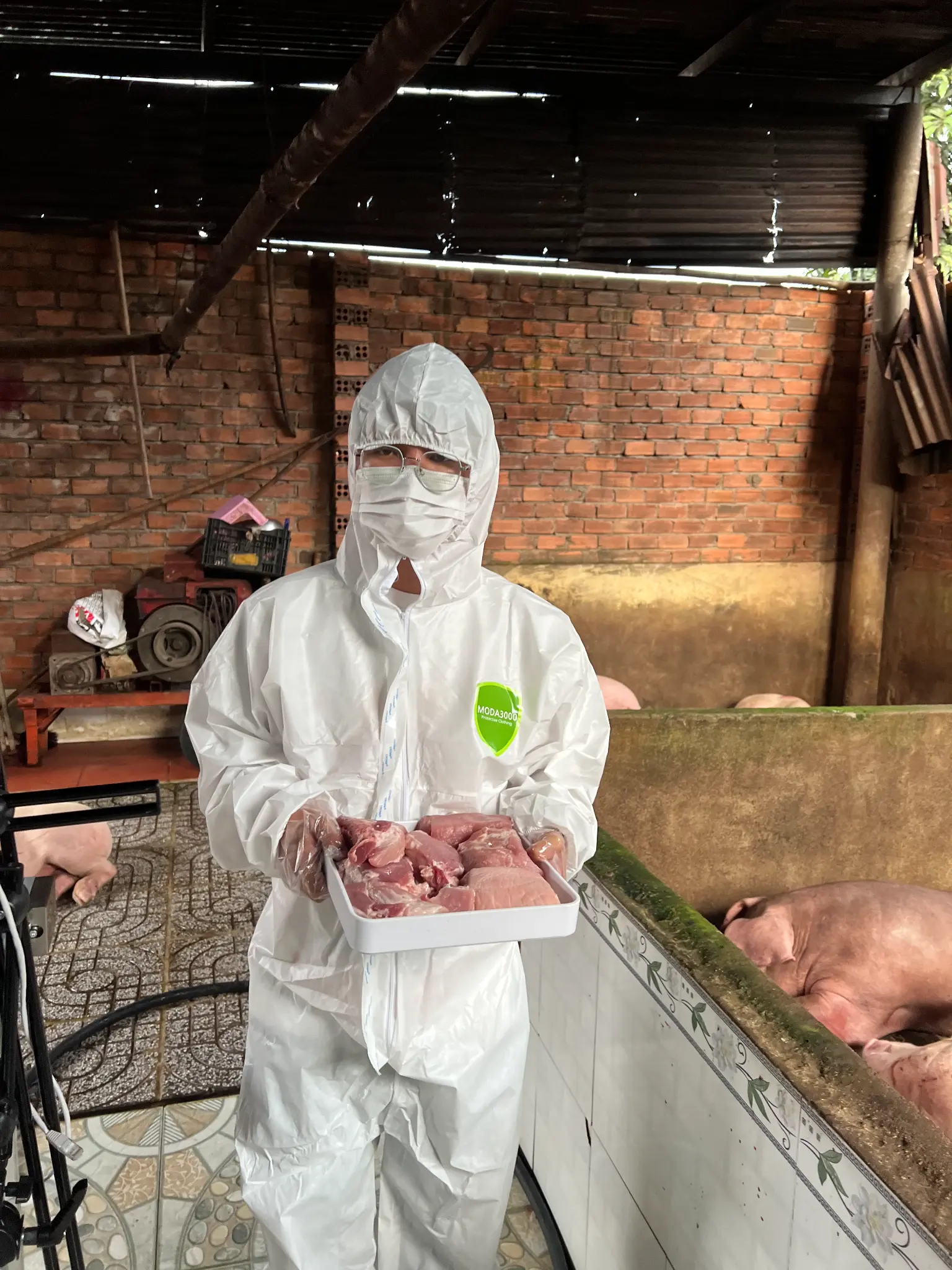
The challenge in Dong Nai, Ho Chi Minh, Vietnam, was entirely different: managing a herd of over 3,000 pigs in a hot, humid, and often volatile tropical climate. Traditional systems struggle immensely in such environments, leading to massive stress, heat exhaustion, and high mortality.
The Challenge: The primary risk was heat stress, which severely impacts FCR and can lead to catastrophic losses during peak summer months. Manual cooling systems were energy-intensive and often failed to provide consistent relief.
The Trackfarm Solution: Trackfarm’s AEC system demonstrated its adaptability and robustness by focusing on advanced cooling and dehumidification strategies. The AI integrated local weather station data to predict high-humidity events and proactively adjusted the misting and ventilation systems to maintain a critical thermal-humidity index.
The Results:
- Local Optimization: The AI successfully maintained a cool, dry, and clean environment despite the external heat and humidity, a feat that local farmers considered impossible with traditional technology.
- High-Quality Rearing: The system successfully maintained the necessary conditions for “high-quality rearing,” translating into a premium product and, more importantly, zero heat-related mortality during the hottest months of the year.
- Energy Efficiency in Cooling: By precisely controlling the misting and fan usage, the system achieved the necessary cooling effect with significantly less energy than a constantly running, manually controlled system.
This case study proves that the AEC system is a powerful risk mitigation tool, ensuring stable production and profitability even in the most challenging environmental conditions.
VIII. The Investment Perspective: Calculating Return on Investment (ROI)
For farm owners and investors, the decision to adopt Trackfarm AEC is a clear ROI calculation. The system is not an expense; it is a capital investment that generates immediate and sustained returns.
The ROI is driven by the combined effect of:
- Direct Cost Savings: Reduced labor, feed, and energy costs.
- Revenue Generation: Increased throughput (shorter cycle) and reduced loss (lower mortality).
For a typical 3,000-head farm, the annual savings and increased revenue potential can easily exceed $150,000. This means the system can often pay for itself within 18 to 36 months, after which the savings become pure profit. Furthermore, the system future-proofs the farm against rising labor costs and increasing environmental volatility.
IX. Conclusion: The Future of Profitable Swine Farming
The economic future of swine farming is not about working harder; it is about working smarter. Trackfarm’s Automated Environmental Control system is the key to unlocking maximum profitability by eliminating environmental variability and minimizing labor dependency.
By transforming the barn environment from a liability into a perfectly controlled asset, Trackfarm delivers a powerful return on investment through:
- Drastic Labor Reduction: Freeing up managers to focus on strategic tasks, not manual adjustments.
- Optimized Operational Costs: Saving money on feed, energy, and veterinary care through AI-driven precision.
- Increased Throughput: Getting pigs to market faster and reducing costly mortality, maximizing annual revenue.
The unseen hand of the Trackfarm AEC system is the most valuable partner a modern farmer can have, ensuring a stable, predictable, and highly profitable operation. The time to adopt this smart farming revolution is now, to secure a competitive edge in the global market and build a sustainable, high-yield future.

Leave a Reply